
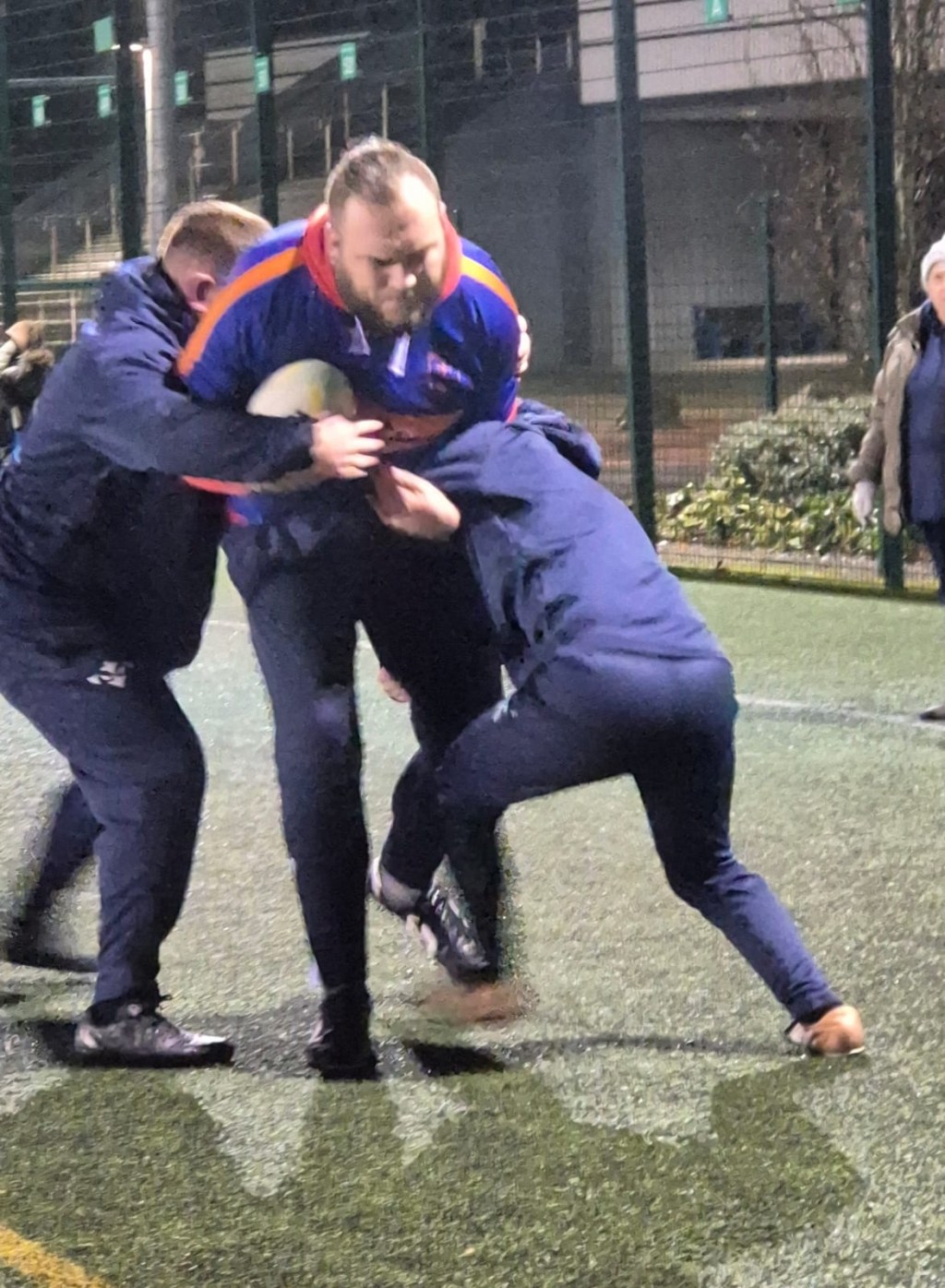
When I was registered as blind in June of 2021 (the day after my birthday, in a bit of unfortunate timing), there were many things I imagined I would never do again. Drive a car, for one, I had to give up my license immediately, but one thing I certainly didn’t think I would ever do again was play rugby.
Full disclosure, I hadn’t actually played rugby in a long time, even before I lost my sight, so it wasn’t as if it was something I gave up per se, but I certainly didn’t ever think I would play again, and certainly not for the club I’ve spent my life supporting, in any form.
I first learned about PDRL a few years ago, via Adam Hills, the comedian, TV presenter, and current president of the RFL. I’m a big fan of Adam’s, and the show he presents The Last Leg, during which he frequently mentioned his love of rugby league and his participation in PDRL, playing for Warrington Wolves. He even presented a documentary for Channel 4 in 2019 called Take His Legs (Hills was born without a right foot, making this title a pun on his disability, and RL tackling technique), about the PDRL World Cup, which took place in 2022, alongside the other three World Cups.
After learning of this version of the sport I loved, and realising it was one I could participate in, I had umm’ed and ahh’ed about giving it a go for at least the last year. Firstly, I hadn’t played rugby since my early teens, at least fifteen years ago at this point, I’m approaching thirty and my body is not in what you would call peak condition. However, in January, my schedule cleared on training nights and I figured it was time to shit or get off the pot if you’ll pardon the expression.
So that’s how I ended up on an all-weather pitch, on a freezing-cold January evening, in a pair of boots that had spent more time in the bottom of a cupboard than they had on my feet, for my first training session. Afterwards, I was exhausted, exercise doesn’t come naturally to me, but felt more alive than I had in a long time, and like this was something I could do, and maybe even do well.
I didn’t know before training how I would catch a ball. I have less than a foot of functional eyesight left, by the time I can see the ball, it might have already fit me in the face. I found that I could catch the ball though, I can’t really explain how, but I can hear the ball in flight, and as long as I’m prepared to catch it, there’s a good chance that I will, then I just have to hope I’m facing in the right direction in which to run.
It’s a lot more complicated than just hearing the ball, of course, rugby league is a team sport, and I also rely on my teammates to indicate when a ball might be coming my way so I know when to be alert. Communication is key to helping everyone through the game, making PDRL incredibly inclusive and welcoming, as the team adapts to each player and the adjustments they might need to contribute towards the game.
I’ve been going for four or five weeks now, and despite only being around the team for a short while, I feel like I’ve been there for years, such is how I’ve been welcomed into the fold and the feedback I’ve got. Each week it’s getting a bit easier to keep up with everyone, and the aches and pains are lesser with each session, I’ve even started going to the gym to get my fitness up a bit, and the gym isn’t my natural habitat, let me tell you.
One of the greatest things about PDRL is the inclusivity of people of all different ages, ages and disabilities. There are people with experience, some like me who have been out for a while, and all those in between. Although I am one of the more senior team members in terms of age, there are people older than me who still play. The game is even open to those who cannot play full-contact rugby league, such as players with head or neck injuries, who play with red shorts, and cannot be tackled, but still play a crucial role in the team.
As well as PDRL, there is LDRL, or learning disability rugby league, which also opens up sports for those with learning difficulties, and these teams are operated (as a rule, I’m not sure if this is universal) by the charitable foundations of professional clubs, offering the players of these teams to pull on the jersey of the club they love. One memory I’ve made so far that won’t be fading anytime soon is being included in the Hull KR team photo, alongside all the other teams under the Rovers umbrella.
With a bit of luck, I’ll be playing my first match next month in a “friendly” against Hull FC’s PDRL team (is there ever such a thing as a friendly derby?), and from there on I’ll be working hard to play as much as possible for the season ahead (played in a festival format, once a month). I don’t know how long I’ll be able to play the game, but I’ve spent the past decade and a half, if not more, off the pitch, and my experience so far makes me want to stay back on the pitch as long as possible.
I’ve titled this post ‘Part 1’ in case it finds an interested audience. In that case, I’ll continue to provide semi-regular updates from my time in PDRL.
If you’d like more information on PDRL, you can find it on the RFL website here: https://www.rugby-league.com/get-involved/play/physical-disability-rl. Check with your club foundation to find out more about their team.
Written by Nathan Major-Kershaw (site editor & Hull KR fan)
 Gerrim Onside!
Leave a comment