
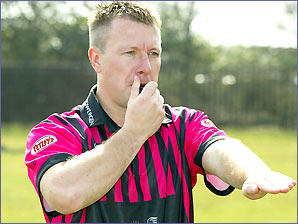
Referees; Is there a more divisive topic in rugby league, or indeed, in most sports? It seems to me like they are becoming more of a talking point than the games themselves these days, much to the disgruntlement of fans and pundits alike.
At the very start of this website a scant few weeks ago, I put out an opinion piece about refereeing and the buzzword we hear a lot of ‘consistency’ and how it’s a more or less unobtainable goal (you can read the full thing here, it’s much more insightful than I’m making it sound), and in that column, I briefly touched on video refs, and so was planted the seed for the two pieces released on here from myself and Ian, looking at that very topic, and arguing the pros and cons, with Ian being firmly against the concept, and myself being in favour of it. Maybe somewhere in our arguments, we can find some middle ground. Probably not though, as he’s a Hull FC fan (boo, hiss) and I’m a Hull KR fan (majesty fanfares play from on high).
Wasting no time then, I’ll get straight to my main point. The reason technology is here to stay and is the right way forward is that it makes financial sense to make sure every call is as accurate as possible. Now, in reality, we know that it is often far from true, but in theory, multiple sets of well-trained eyes with access to technology to scrutinise events make the chances of a disastrous error less likely. This is more important now than it has ever been simply because of the amount of money that goes into sports. We may not like it, but sport is a business now, a business with perilous financial consequences should things go wrong.
For example, cast your mind back a few years to the advent of the ‘Million Pound Game’ facilitated by the dreadful Middle 8’s play-off system. That game got its name from the extra £1 million in revenue that comes from the Super League’s Sky deal. Given that incredible gulf in revenue, it only makes sense that the teams involved would want every decision, which could make or lose them a million pounds, scrutinised as much as possible. When you’re playing with margins of profit and loss like that, you simply cannot afford to put game-changing decisions on the head of one referee. Especially since the technology exists, and the sport is being bankrolled by a multimedia juggernaut. It would be irresponsible now we have used it to reverse tact when the potential losses for those on the wrong end of a decision are so vast.
Like it or not, rugby league would not be where it is today without Sky. Arguably, the game would be entirely semi-professional without their broadcast deals. Don’t believe me? Just look at the clubs in the Championship who are trying to compete without that revenue. The vast majority of them are part-time, semi-professional clubs.
Having read Ian’s opinions before writing my own, I have to concede that he makes some good points. Yes, the video ref is used far too often. Yes, some decisions take far too long to be rubber-stamped, and yes, it does make the in-goal touch judges a bit redundant, especially since every Super League match is televised now, but I believe these are aspects that can be tweaked and improved upon to make the video ref a valuable asset, instead of a derided sideshow it is increasingly becoming.
First and foremost for reforms, written on top of my list in gold dust, is time limits for decisions. I can accept Ian’s position that the video ref can take supporters out of the game, but I think this is only generally the case when decisions are dragged out for maximum dramatic effect. A quick thirty-second double-check to make sure the ball was properly grounded or a kick-receiver was onside shouldn’t affect your enjoyment of a game, and that’s all that should be needed. Either put a time limit on them or limit the number of times the video ref is allowed to analyse a replay so we can get on with the game, hopefully with the correct decision. This would make things quicker, and refine the referee’s senses to make a decision more decisively because of the constraints.
Secondly, this time written in silver dust, scrap the system of sending decisions up as try/no try. The reason they’ve sent the call up to the big screen is that they’re not sure, so are we to take it that refs are just guessing when they send it up as a try? How sure do you have to be before sending it up as a try? The fact the video ref has to find evidence to prove/disprove the on-field decision can only add to the time spent dawdling and deliberating. It’s okay to not be sure, you’re only human, but to have to guess one way or another weakens the referee’s position.
There are multiple other things I can suggest to improve the system, maybe limiting the number of times the ref can use the screen, for example, or implementing the use of pitch side monitors like football’s VAR uses, for both referees to collaborate on the best decision. Or maybe not, as every match could end up lasting a fortnight if football’s example is anything to go by.
To conclude this rough wander through my thoughts on this debate, I think the video referee as a concept is an excellent idea. It takes crucial decisions out of the hands of just one man, therefore theoretically increasing the chance of it being correct (again, I emphasise theoretically). It’s a flawed system, absolutely, but it is worth sticking with. As much as many people (most of all Ian) will protest, sport is entertainment, made for spectators who are invested in the right decisions being made for their teams. It shouldn’t be the talking point at the end of the game, but it does help make a referee’s difficult job marginally less tough knowing that he has another professional referee to call on with the help of several millions of pounds worth of recording equipment to comb through frame by frame. Now the genie is out of the bottle I’m afraid, and it’s something we’re going to have to make work.
Now that sorted, maybe we can take on a slightly less divisive topic next time. Like Brexit, perhaps?
Written by Nathan Major-Kershaw (Site editor & Hull KR fan)


Leave a Reply