
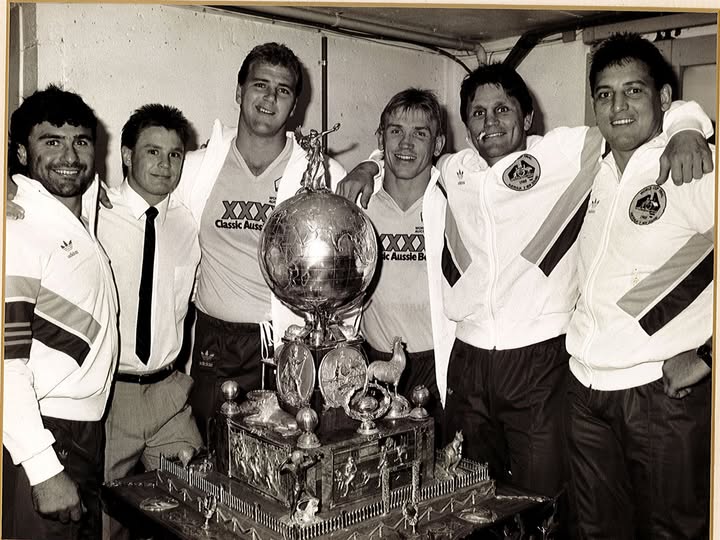
Do you think this World Cup format is a bit convoluted? Questionable even? Well, let me tell you, this doesn’t even take the cake for the weirdest Rugby League World Cup formats. No, dear reader, there were two even more bizarre tournaments in the competition’s history. Let me introduce you to the utter madness of the 1985-1988 and 1989-1992 World Cups.
You’d be forgiven for thinking that the last line of the above paragraph is a typo. It is not. There were not one but two World Cups that took place over multiple years. Eight years in total were split between two World Cup tournaments. The 1985-88 competition took place from July of 1985 to October of 1988, and the 1989-92 one from July of 1989 to October of 1992. I’ve recently been looking at this in more detail as I work on the second edition of the Gerrim Onside Rugby League Almanac, and thought it an interesting nugget of rugby league history to share with you all.
This wasn’t the first time the format had been tinkered with. Two early World Cups operated on a ‘first past the post’ system, with the team that performed better in the group stage taking home the trophy, with no need to play a final; then, in 1975, the format returned to a group-based system, but this time the tournament did not simply take place in one host country (that’s far too sensible), but was played instead in five different countries (France, England, Australia, New Zealand, and Wales) over the course of six months.
Like the 1975 version (which was called the ‘World Championship Series’ instead of World Cup), the 85-88 & 89-92 versions were also played across five different countries (Australia, England, New Zealand, France, and Papua New Guinea this time around), but at least had the decency to spread itself over four years, and that’s as close to praise as I’m going to get with this format.
In the former of the two World Cups, France couldn’t even fulfil all of their fixtures; they had to forfeit three games (against Australia, New Zealand, and Papua New Guinea) because of the costs involved with travelling. You see, in this version of the format, each nation played each other home and away, with the top two of the five-nation group competing in the final. This is all very well for Australia, New Zealand and PNG, as we’ve seen with the current tournament; it is feasible to host a tournament across those three nations, but spare a thought for the Northern Hemisphere sides; no wonder France couldn’t manage it. Mercifully, for Great Britain, their fixtures against the three Southern Hemisphere countries were grouped together, but there was still a nearly two-month gap between their fixture against PNG and their next against Australia (they won both. I know, a British team beating Australia- will wonders ever cease?).
I am amazed that this absolutely insane format survived for more than one iteration of the competition. After the 89-92 tournament wrapped up, the next one returned to a sensible format once more, one (or two, or at a push three) nation hosts over a month, following the end of the season. The 1995 iteration was held in England and Wales, for those wondering.
That’s just the format, though; what about the results on the pitch? Well, Australia won both tournaments (quelle surprise), but there were a few surprise results along the way. Chief amongst these was a stunning victory for Papua New Guinea against New Zealand in their very first World Cup fixture. They beat the Kiwis 24-22 in Port Moresby, in what I can only imagine was an electric atmosphere. Sadly, that was as good as it got for the Kumuls, as they wouldn’t get another win (on the pitch, anyway; they were awarded the points due to France forfeiting their game) for the rest of the tournament.
Elsewhere, France held Great Britain to a draw in Avignon, and would beat Papua New Guinea in Carcassonne. Both New Zealand and Great Britain beat the Aussies in the group stage, with the Lions’ victory over the Kangaroos taking place in Australia itself, a rare feat indeed.
The 1989-1992 tournament, however, saw no real shocks to speak of, although PNG came close to beating the Kiwis once again in Port Moresby. The tournament came to an end at Wembley in 1992, with the Kangaroos downing a Great Britain side that contained such greats as Martin Offiah, Garry Schofield, and Shaun Edwards 10-6.
All of this goes to show that, in rugby league, things can always get stranger. The format for this tournament may seem lopsided, but at least it’s being held in vaguely the same geographical area. At least everyone has been able to afford to fulfil their fixtures. Whether the result of an Australian win once again happens remains a question for the future, but you can be certain that the 2026 Rugby League World Cup isn’t the strangest iteration of the competition. Not by a long chalk.


Leave a Reply